


Investment Guide • 4 min read
The MET City Effect on Housing Demand
With Reliance MET City bringing industrial activity, global businesses and employment momentum to Jhajjar, the region is seeing a stronger case for planned residential and commercial infrastructure.
How industrial growth is creating a stronger case for planned housing in Jhajjar
Housing demand does not become sustainable simply because land is available. It becomes sustainable when people have a reason to live in a region, when jobs, businesses, roads, healthcare and everyday services begin to form a functioning ecosystem around it.
That is the change now taking shape in Jhajjar.
At the centre of this transition is Reliance MET City, a large integrated industrial township that has brought manufacturing, multinational businesses and employment activity into the district. Its growth is gradually shifting the perception of Jhajjar from a peripheral land market to an emerging employment and residential corridor within the wider National Capital Region.
The relationship is not automatic. Not every employee working at MET City will buy or rent a home in Jhajjar. Many may continue to commute from Gurugram, Rohtak, Bahadurgarh or surrounding towns. Yet a growing employment base creates the most important foundation for real housing demand: a sustained population that needs somewhere practical, organised and affordable to live.
For investors, the opportunity lies in understanding how this employment ecosystem may influence land and housing demand over time. For future homeowners, the question is more personal: can Jhajjar evolve into a well-planned, connected and liveable place to build a life?
Company-reported and publicly reported figures. Investment MoUs and projected employment remain subject to implementation.
MET City: An Employment Anchor at Scale
Reliance MET City, developed by Model Economic Township Limited, is planned across approximately 8,250 acres in Jhajjar. The township brings together industrial, commercial and residential uses within one wider economic ecosystem.
By 2026, MET City reported that more than 650 companies from 11 countries had set up industries within the development. Its business mix spans auto components, electronics, medical devices, engineering, defence, footwear, packaging, consumer products and other manufacturing sectors.
The significance of this scale extends well beyond the factory gates.
Every industrial facility supports several layers of economic activity. Alongside production workers and technicians, it requires engineers, managers, logistics providers, transport operators, maintenance teams, security staff, vendors, food services and professional support. These direct and indirect roles expand the number of people who work, travel and spend within the surrounding region.
MET City reports that it has already supported more than 40,000 jobs. In June 2026, two memoranda of understanding covering proposed investments of approximately ₹8,646 crore were also announced, with more than 33,250 additional jobs projected if those investments are implemented as planned.
The distinction matters. Existing employment represents present economic activity. Jobs connected with MoUs remain projected. Both contribute to the region’s long-term direction, but they should never be presented as the same thing.
Employment is the bridge between industrial investment and housing demand. The more diverse and established the local workforce becomes, the stronger the need for homes, rentals, shops and services within a practical commuting distance.
How Jobs Can Translate into Housing Demand
A workforce of this scale does not create one single category of housing requirement.
Factory workers, junior employees and contractual staff may prioritise affordable rentals or shared accommodation. Technicians and supervisors may seek practical homes closer to their workplaces. Engineers, managers, entrepreneurs and business owners may prefer organised plotted developments, gated communities or larger family homes.
Some senior professionals may continue to live in established NCR locations. Others may consider moving closer to work if nearby housing can provide reliable infrastructure, security, schools, healthcare, green spaces and everyday convenience at a more accessible price point.
The demand cycle generally develops in stages:
- Companies establish operations and attract investment.
- Direct and indirect employment grows.
- A larger workforce begins travelling through the region every day.
- A portion of that workforce seeks to reduce commute time by living nearby.
- Families create demand for schools, healthcare, retail and recreation.
- Local businesses require offices, shops, storage and staff accommodation.
- Planned residential sectors become increasingly relevant as the wider ecosystem matures.
The process is gradual, not guaranteed. Housing demand will depend on project quality, affordability, infrastructure delivery and whether people begin to see Jhajjar as a place to live, not only a place to work.
The Demand Extends Beyond Homes
The MET City effect is unlikely to be limited to residential plots or apartments.
A growing working and resident population also needs grocery stores, pharmacies, clinics, schools, restaurants, banks, offices and neighbourhood services. Manufacturing and logistics businesses create parallel demand for warehousing, commercial plots, professional accommodation and supporting business infrastructure.
This creates a broader urban-development cycle:
Industry creates employment. Employment supports habitation. Habitation supports commerce, healthcare, education and community life.
For Jhajjar, the long-term opportunity is therefore larger than the sale of individual plots. It is the possibility of building organised neighbourhoods around a functioning employment ecosystem.
Sector 36 Within Jhajjar’s Planned Residential Expansion
The official Final Development Plan 2031 for Jhajjar identifies Sectors 36 and 37 within the city’s planned residential framework. This gives the area a formal place in Jhajjar’s future urban expansion rather than positioning it as an isolated or unplanned land pocket.
The plan also reserves land for major roads and supporting urban uses. Its road schedule identifies the V-1 outer peripheral and Jhajjar–Gurgaon road as a 75-metre-wide corridor with a 30-metre green belt on both sides.
A master plan establishes the intended direction of development; it does not prove that every proposed road or service is already complete. The real benefit of that planning is realised only when roads, utilities and civic infrastructure are delivered on the ground.
For investors, this distinction is central to evaluating timing and risk. For homeowners, it determines when a planned location can begin functioning as an everyday neighbourhood.

From South City 1 to South City Greens: The Evolution of a Micro-Market
Sector 36’s residential story began taking shape before the launch of South City Greens.
According to historical launch material supplied by Cellular Realty, South City 1 entered the Sector 36 market in 2022 with opportunities starting from approximately ₹18 lakh. In 2026, South City Greens is being introduced within the same Sector 36 micro-market, with current opportunities starting above ₹50 lakh.
This is not a direct like-for-like appreciation calculation.
South City 1 and South City Greens are two separate projects introduced four years apart. Their plot sizes, development specifications, inventory, infrastructure, charges and market positioning may differ. The two starting prices should therefore not be used to claim that one identical property has appreciated from ₹18 lakh to ₹50 lakh.
What the comparison does show is an evolution in the entry threshold for organised plotted development within the same location. Sector 36 has moved from an early-stage plotted market towards a more established residential micro-market, alongside greater awareness of Jhajjar’s industrial growth and infrastructure story.
For investors, the change offers a useful historical reference for how the market’s positioning has evolved. The future investment case must still rest on sustained demand, project execution and infrastructure delivery, not on the assumption that earlier price movement will repeat.
For homeowners, South City Greens represents a different proposition. The decision is not only about future value. It is about whether the project can become an organised, comfortable and well-connected address for everyday life.
2022 · South City 1
- Sector 36, Jhajjar.
- Starting from approximately ₹18 lakh.
2026 · South City Greens
- Sector 36, Jhajjar.
- Starting from ₹50 lakh+.
Same Sector 36 micro-market. Four years of development and market evolution.
South City 1 and South City Greens are separate projects and may differ in plot size, specifications, inventory and charges. This comparison reflects starting entry levels within the same micro-market, not a guaranteed return or an identical-property price index.
What the South City Greens Layout Shows
The current South City Greens layout supplied by the project team identifies the development in Sector 36, Jhajjar and presents a planned mix of residential plots, internal roads, landscaped areas, commercial space and a community-facility zone.
The visible plan includes:
- a proposed 75-metre-wide road along the project edge;
- a landscaped green belt;
- a 12-metre-wide service road;
- predominantly 9-metre-wide internal roads;
- a commercial pocket near the main approach;
- a large community-facility area;
- landscaped and recreational spaces;
- multiple residential plot configurations.
These features are relevant to both audiences.
For investors, road hierarchy, planned access and commercial positioning can influence future movement and marketability. For homeowners, internal circulation, green spaces, community facilities and access to daily needs have a direct effect on liveability.
The layout should be displayed as a project-planning visual. Any legal claim concerning final approval, total area, plot entitlement or development obligation must be checked against the applicable DTCP licence, approved layout and RERA disclosures.

Connectivity Today, and the Catalysts Still to Come
Jhajjar’s housing outlook is supported by a combination of infrastructure that already exists and connectivity projects that remain subject to future execution.
Reliance MET City highlights access to the operational Kundli–Manesar–Palwal Expressway, which supports industrial logistics and regional movement around the NCR. Jhajjar also has an existing railway station and established district-level administrative infrastructure.
The district is home to the National Cancer Institute at Badsa, the second campus of AIIMS New Delhi. Its presence adds major healthcare infrastructure to the wider Jhajjar region.
Future connectivity could further expand the area’s residential catchment. The Haryana Orbital Rail Corridor is planned as an electrified broad-gauge railway connecting Palwal and Sonipat through key industrial areas, with links to existing railway lines and the Dedicated Freight Corridor network.
A separate proposed six-lane road between the Harsaru side of Gurugram and Jhajjar is also progressing through the planning process. As of July 2026, NHAI was evaluating three alignment options for the approximately 33-kilometre corridor.
If implemented, the road could materially improve accessibility. It must, however, be presented as a future catalyst, not as an existing connection. Projected travel-time claims should not be treated as current or guaranteed facts.
What the Story Means for Investors
The investment case for Sector 36 is based on a combination of fundamentals rather than one headline or one future road.
It includes:
- a functioning industrial anchor at Reliance MET City;
- a reported employment base exceeding 40,000 jobs;
- further investment and employment commitments subject to implementation;
- residential designation within the Final Development Plan 2031;
- a higher entry threshold across successive Sector 36 projects;
- existing regional connectivity through the KMP Expressway;
- future road and rail projects that may strengthen access over time.
These factors could support long-term residential demand, but they do not remove risk. Infrastructure can be delayed. Employment does not always convert into nearby home ownership. Plotted developments may require a longer holding period before the surrounding area becomes fully occupied and liveable.
A responsible investor should therefore evaluate actual development progress, legal documentation, on-ground access, neighbourhood growth, resale liquidity and the ability to hold through a long development cycle.
What the Story Means for Future Homeowners
For a homeowner, the decision should extend well beyond appreciation potential.
A future residential address must work in everyday life. Buyers should consider:
- completion and quality of internal roads;
- water, electricity, drainage and sewerage arrangements;
- security and maintenance systems;
- access to schools, healthcare and daily-needs retail;
- delivery of green spaces and community facilities;
- actual travel time to work and important destinations;
- surrounding occupancy and neighbourhood development;
- the project’s current legal and regulatory status.
South City Greens’ position within a planned residential sector and its current layout create a promising framework. Its success as a community will ultimately depend on how effectively that framework is delivered.
An Employment-Led Demand Story, Not a Promise of Returns
Jhajjar’s residential case is becoming more credible because it is increasingly connected to visible economic activity.
Reliance MET City provides a substantial industrial and employment anchor. Sectors 36 and 37 form part of Jhajjar’s planned residential expansion. Existing infrastructure already supports the region, while proposed roads and the Haryana Orbital Rail Corridor may strengthen connectivity over time.
South City 1’s 2022 launch provides an early reference point for Sector 36. The 2026 introduction of South City Greens, at a higher entry threshold, represents the micro-market’s next stage. It is evidence of changing positioning, not a guarantee of future appreciation.
For investors, the opportunity lies in a long-term, employment-led growth story that remains subject to infrastructure and project execution. For homeowners, it lies in the possibility of entering a planned community as Jhajjar’s industrial, civic and residential ecosystem becomes more established.
The strongest property decisions will be made by buyers who evaluate both sides of the story: future potential and present-day due diligence.
Buyer Due-Diligence Checklist
Before making a property decision, independently verify:
- DTCP licence details;
- RERA registration and current disclosures;
- land title and ownership records;
- the approved layout plan;
- exact plot dimensions and location;
- current on-ground access;
- development and possession status;
- utility and maintenance arrangements;
- status of proposed roads and public infrastructure;
- total cost, including all applicable charges and taxes.
Disclaimer
This article is intended solely for informational and educational purposes and does not constitute financial, investment or real-estate advice. Company figures, employment projections, investment commitments, infrastructure timelines, project plans and prices may change. Proposed roads, rail corridors and master-plan infrastructure are subject to approvals, land acquisition, funding and execution. The comparison between the 2022 starting price of South City 1 and the 2026 starting price of South City Greens concerns two separate projects within the same Sector 36 micro-market and should not be interpreted as a guaranteed, uniform or like-for-like investment return. Readers should independently verify DTCP licences, RERA registrations, titles, approved plans, current site conditions and total pricing before making a financial commitment.
Source Notes
-
Reliance MET City official website: planned area, reported company presence, employment figures and KMP access. https://www.metcity.in/
-
The Economic Times, 3 June 2026: ₹8,646 crore MoUs and projected employment associated with the announced investments. https://economictimes.indiatimes.com/industry/services/property-/-cstruction/mukesh-ambani-led-reliance-inks-mous-with-haryana-govt-to-invest-rs-8646-cr-in-jhajjar-township-project/articleshow/131480976.cms
-
Final Development Plan 2031 A.D., Jhajjar (supplied asset:
FDP Jhajjar 2031 (1).pdf). -
South City Greens Layout Plan, Sector 36, Jhajjar (supplied asset:
south-city-greens-project-plan.pdf). -
AIIMS New Delhi, National Cancer Institute, Jhajjar. https://aiims.edu/index.php/hi/about-us/258-nci_jajjar/13968-intro-nci-jhajjhar
-
Haryana Rail Infrastructure Development Corporation, Haryana Orbital Rail Corridor documentation. https://hridc.co.in/
-
Hindustan Times, 17 July 2026: three alignment options under evaluation for the proposed Gurugram–Farrukhnagar–Jhajjar highway. https://www.hindustantimes.com/cities/gurugram-news/nhai-identifies-three-alignment-options-for-gurugram-farrukhnagar-jhajjar-highway-101784225131848.html
-
Internal commercial evidence supplied by Cellular Realty: South City 1 launch starting price in 2022 and South City Greens launch starting price in 2026. Preserve both original visuals internally before publishing the comparison.
Related Project
South City Greens
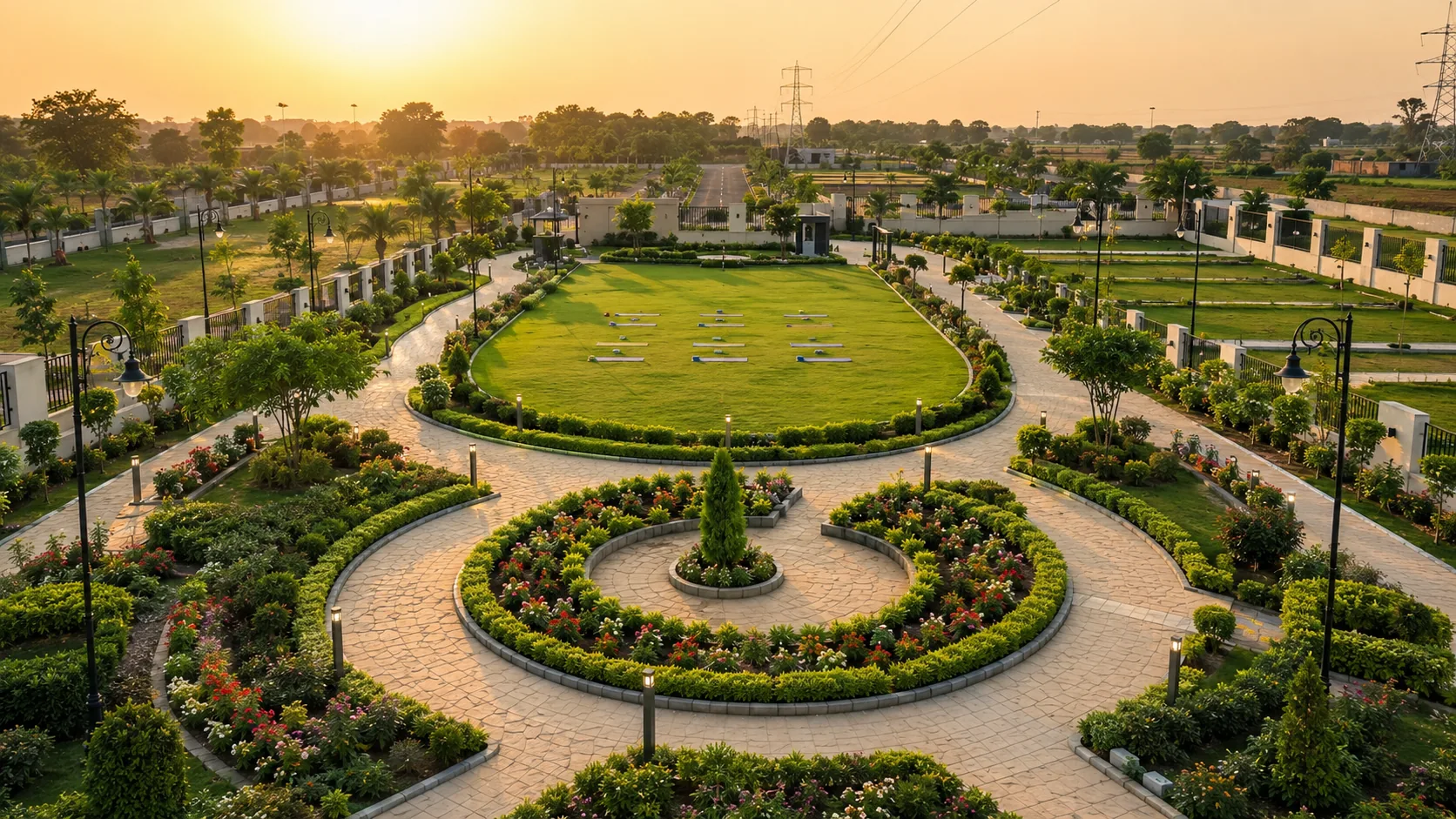
Sector 36, Jhajjar